
Short answer
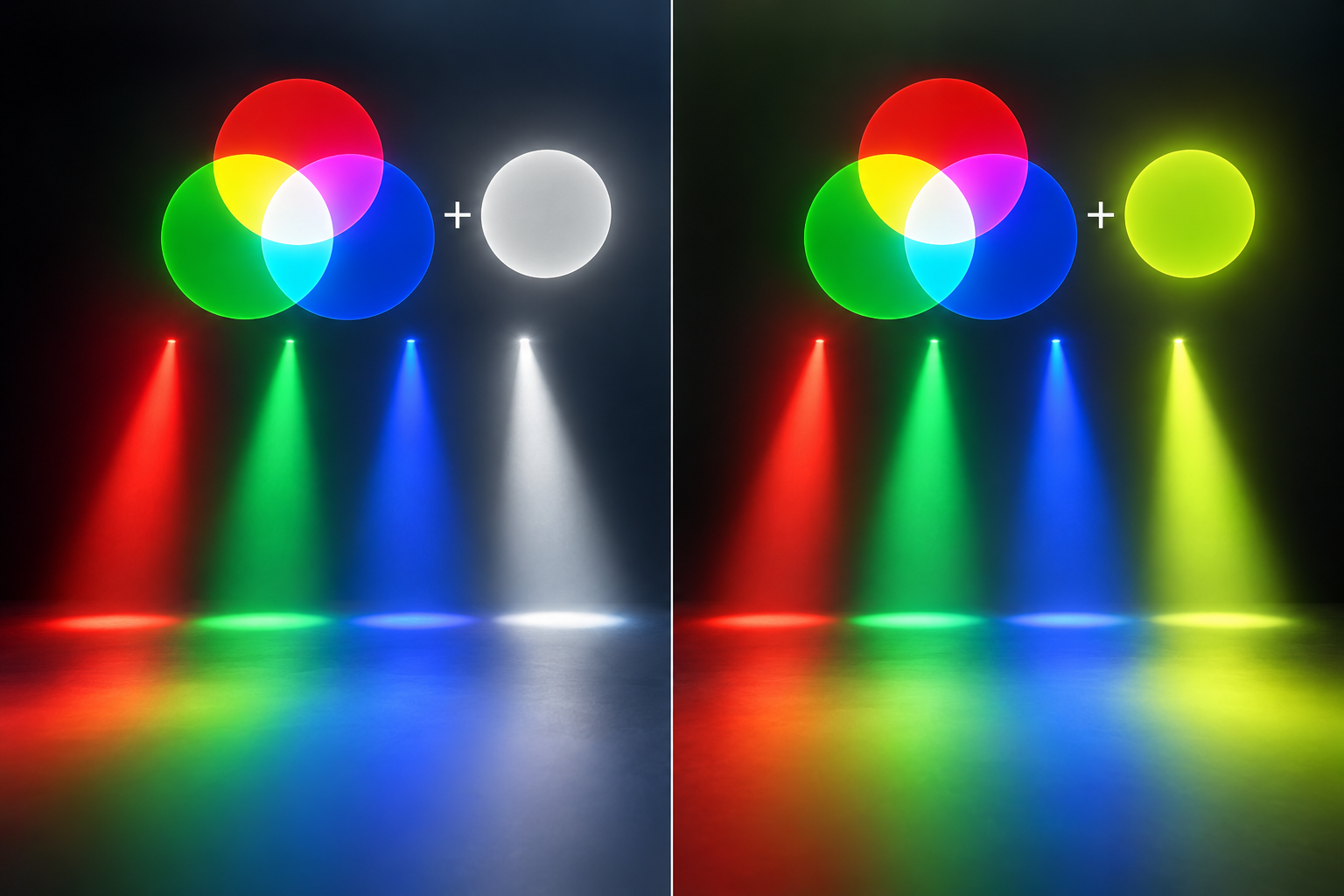
RGBW adds a white emitter to red, green and blue. RGBL adds a lime emitter instead.
The white emitter helps with whites and pastel tints. The lime emitter helps with saturated yellows, ambers and yellow-greens, and with the quality of mixed whites.
Neither is better in every situation. They solve different weaknesses of an RGB mix.
[confirm: which fixture ranges use RGBL, and whether "Lime Engine" is the name used for the lime emitter in those ranges]
How each system makes color
RGB as a starting point
Red, green and blue emitters mix additively to produce a wide range of colors. Both RGBW and RGBL build on this mix, so it helps to know where it falls short. Two weaknesses are common:
Yellows and ambers. When made from red and green, these are often dim and can look slightly green or muddy.
Whites. Whites made from red, green and blue have a narrow, spiky spectrum. Skin tones, fabrics and set pieces can look off under them, and cameras may show a color cast.
RGBW
RGBW adds a white emitter. In general terms:
Whites and pale tints are brighter and cleaner, because the white emitter produces them directly.
The white emitter typically has a broader spectrum than a mix of red, green and blue, so objects usually look more natural.
Pastel colors are easier to produce, because white can dilute a saturated color without dimming the output as much.
The color temperature of the white emitter varies between products. [confirm: color temperature of the white emitter, if the article is to refer to it]
The white emitter adds little to saturated colors, so yellows and ambers can still be weak.
RGBL
RGBL adds a lime emitter, which sits in the yellow-green part of the spectrum, between green and red. In general terms:
Yellows, ambers and yellow-greens are brighter and more saturated, because a dedicated emitter produces them instead of a red and green blend.
Warm tones and amber looks, such as sunset or tungsten-style washes, usually gain output and a smoother transition.
Mixed whites can improve, because the extra emitter fills a gap in the spectrum. The result depends on the fixture's design and calibration.
There is no dedicated white emitter, so pale tints and whites are made by mixing. They may not match the brightness or spectral quality of a fixture with a good white emitter.
Where you will notice the difference
Look | RGBW | RGBL |
|---|---|---|
Pale tints and pastels | Usually stronger | Made by mixing; may be less bright |
Neutral or near-white light | Dedicated white emitter | Mixed from several emitters |
Saturated yellow and amber | Often weaker | Usually stronger |
Lime and yellow-green | Mixed from green and red | Dedicated emitter |
Warm sunset-style color | Possible, with limits | Usually smoother and brighter |
Results vary with each fixture's optics, calibration and color-mixing profile, so treat the table as a general guide rather than a prediction for any one fixture.
Choosing between them
Consider what the fixtures will mostly be used for:
If the work relies on clean whites, pale tints and natural-looking skin tones, an RGBW fixture is often the more direct choice.
If the work relies on rich yellows, ambers, warm washes and saturated mixed colors, an RGBL fixture is often the better fit.
If the work is filmed or broadcast, check the fixture's behavior on camera under your own conditions. [confirm: whether any color-rendering or camera-performance data can be referenced]
Comparing on your own rig
A side-by-side test shows the differences in your own conditions, which matter more than a general description.
Place one RGBW fixture and one RGBL fixture side by side, aimed at the same neutral surface, at the same distance and the same intensity. Keeping these the same means any difference you see comes from the emitters rather than from the setup.
[confirm: the remaining steps of the comparison procedure, such as which colors and whites to compare and what to look for. The source material ends after the first step.]