
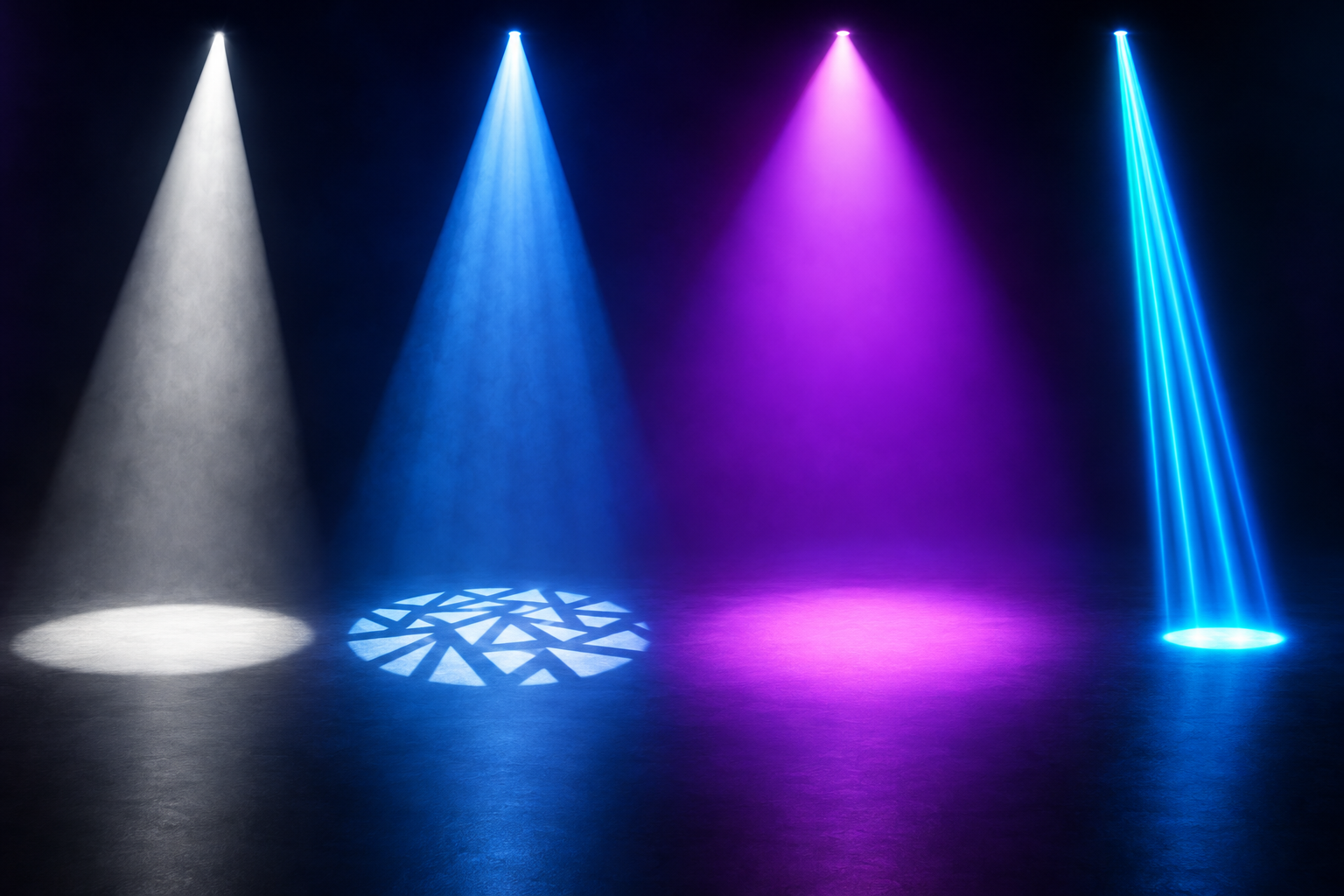
Overview
Stage lighting fixtures are commonly grouped by the optical character of the light they produce: how wide the beam is, how sharp its edge is, and whether the beam can be shaped. This article describes four categories: Beam, Spot, Profile, and Wash.
Beam angle is the spread of the light as it leaves the fixture, measured in degrees. A smaller angle gives a tighter, more concentrated beam.
Categories
Beam
Beam angle: Narrow (<3°).
Character: Ultra-concentrated, with a long throw. Throw is the distance from the fixture to the surface or space it lights.
Typical use: Primarily aerial visual effects. In haze or fog, a very narrow beam stays tight over long distances and shows as a distinct line of light in the air.
Spot
Beam angle: Medium zoom (8°–25°).
Character: Sharp gobo projection and a hard-edged beam. A gobo is a patterned template placed in the light path so that the pattern is projected.
Typical use: Projecting gobo patterns and lighting textured surfaces. A hard edge keeps the projected image crisp.
Profile
Beam angle: 8°–36°.
Optics: Hard-edged spot optics with internal motorized framing shutters.
Character: The shutters are movable blades inside the fixture that crop the beam precisely. They shape the light before it leaves the fixture, rather than relying on external accessories.
Typical use: Fitting light to a specific area or object, for example keeping light off adjacent surfaces.
Wash
Beam angle: Wide zoom (10°–60°).
Optics: Soft-edged Fresnel or pebble-convex optics. These lens types produce a gradual fade at the edge of the beam instead of a sharp boundary.
Typical use: Broad color blending. Soft edges let the light from neighboring fixtures overlap smoothly across a stage, because there is no hard boundary to show where one beam ends and the next begins.
Comparing the categories
Category | Beam angle | Edge quality | Main purpose |
|---|---|---|---|
Beam | Narrow (<3°) | [confirm: edge quality for this category] | Aerial visual effects |
Spot | 8°–25° | Hard-edged | Gobo projection, textured surfaces |
Profile | 8°–36° | Hard-edged, with shutter framing | Precise beam cropping |
Wash | 10°–60° | Soft-edged | Broad color blending |
The Spot and Wash ranges overlap between 10° and 25°. In that overlap, edge quality and optics distinguish the two categories, not beam angle alone.
[confirm: how fixtures between 3° and 8° are classified]
Choosing a category
Decide whether the light needs to fill an area or to project something specific. Filling an area points to a Wash. Projecting a pattern or defining a clear shape points to a Spot or Profile.
If the light must be cropped to a defined area, choose a Profile. Its framing shutters let you control the beam shape from the fixture, so you do not need external accessories to block spill.
If the goal is a visible line of light through the air, choose a Beam. Its narrow angle keeps the beam tight over long distances, which is what makes it show as a distinct line in haze or fog.
Check the beam angle against the throw distance and the size of the area to be lit. A given angle covers a larger area the farther the fixture is from the surface, so the same fixture can suit a small area at a short throw and be too narrow or too wide at another distance.