
Overview
Stage lighting fixtures produce light in one of two broad ways. Discharge fixtures use an arc lamp, and LED fixtures use an LED engine. This article describes how each works and how they differ in use, so you can judge which suits a given application.
[confirm: which fixture ranges use discharge lamps and which use LED engines, so this article can link to them]
What each term means
Discharge lamp
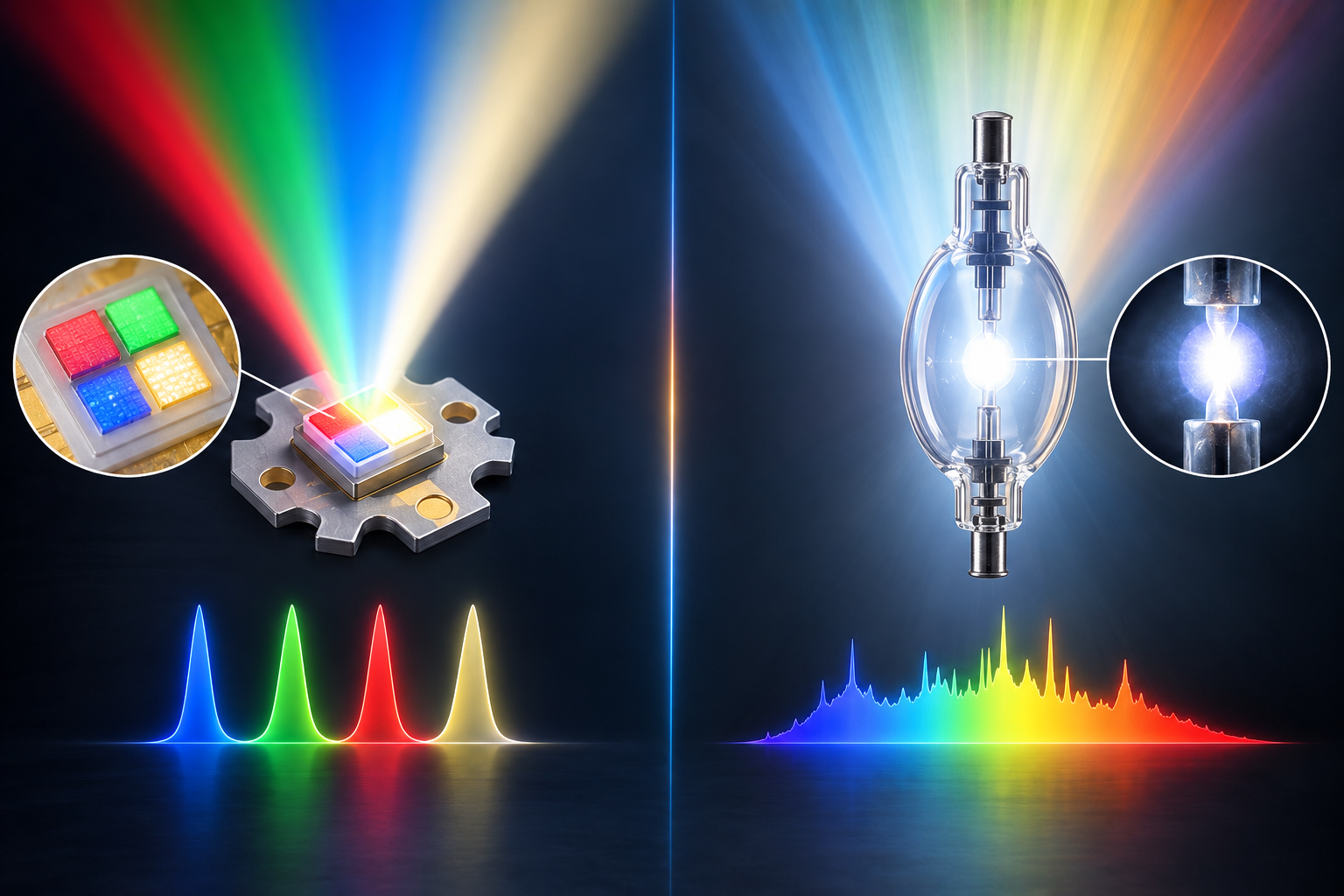
A discharge lamp produces light from an electric arc between two electrodes inside a sealed glass envelope containing gas and metal salts. The arc is a small, intense light source.
Discharge lamps need a ballast or power supply to start and regulate the arc. They are a consumable part: output and color change as the lamp ages, and the lamp is replaced when it reaches the end of its life.
LED engine
An LED engine is the assembly of light-emitting diodes, the circuit board they are mounted on, the driver electronics, and the heat-management components that go with them.
Some engines use white LEDs. Others use several colors of LED, such as red, green, and blue, with additional colors in some designs, mixed to produce a range of colors.
LEDs are solid-state devices with no filament, electrode, or glass envelope to wear out in the way a discharge lamp does.
Key differences
Color
Discharge lamps produce a fixed white light with a characteristic color temperature. Because the lamp itself cannot change color, colors are created by placing filters, such as color wheels or flags, in the light path.
Multi-color LED engines can create colors electronically by mixing emitters, so a color change does not require a filter. The range and quality of colors depend on the LEDs used.
[confirm: the color-mixing capabilities of specific products, if the article should cover them]
Dimming
Discharge lamps generally cannot be dimmed electronically without affecting the arc. For this reason, fixtures typically use a mechanical dimmer or shutter in the optical path, which reduces the light after it leaves the lamp instead of changing what the lamp does.
LED engines can be dimmed electronically, usually by adjusting the drive to the LEDs. The smoothness of dimming at low levels depends on the driver design.
Starting and restarting
A discharge lamp must be struck to start the arc. Many types cannot be restruck until they have cooled, so a lamp switched off during a show may not return to full output immediately. Fixtures typically include a lamp-on or lamp-off control for this reason.
LED engines reach output as soon as they are powered, and they can be switched on and off repeatedly without a cool-down period.
Heat and cooling
Both technologies generate heat and need cooling. Blocked vents or high ambient temperatures affect both types.
Discharge fixtures operate at high lamp temperatures, and the lamp housing and surrounding components must be allowed to cool before servicing.
LED engines run at lower temperatures at the light source, but the LEDs and drivers are sensitive to heat and rely on heat sinks and often fans.
Lifespan and maintenance
A discharge lamp is replaced periodically, and its output declines as it ages. Use is typically tracked in lamp hours so that replacement can be scheduled.
[confirm: whether the product documentation recommends tracking lamp hours, and where hours are shown]
An LED engine does not normally need routine replacement in the same way. LED output declines gradually over a long period, and the engine is normally serviced as a unit or module.
[confirm: whether the LED engine is user-replaceable or serviced only by an authorized technician]
Power use
LED engines generally draw less power than discharge sources of comparable visible output, though the difference varies by fixture. Compare the power figures published for the specific fixtures being considered.
[confirm: where to find power and output figures for each product]
Beam character
A discharge arc is a small source, which suits optical systems that need a tight, well-defined beam.
LED engines use an array of emitters, and the optics must combine their output. Depending on the design, this can affect beam edges, shadows, and how cleanly colors blend. The effect varies widely between designs.
Use with cameras
Some LED fixtures can show flicker or banding on video if the driver's dimming method interacts with the camera's shutter or frame rate. Discharge sources are less likely to show this, but it depends on the power supply and the shutter settings.
Testing on camera before an event is good practice for either type, because the result depends on the specific combination of fixture, settings, and camera.