
Overview
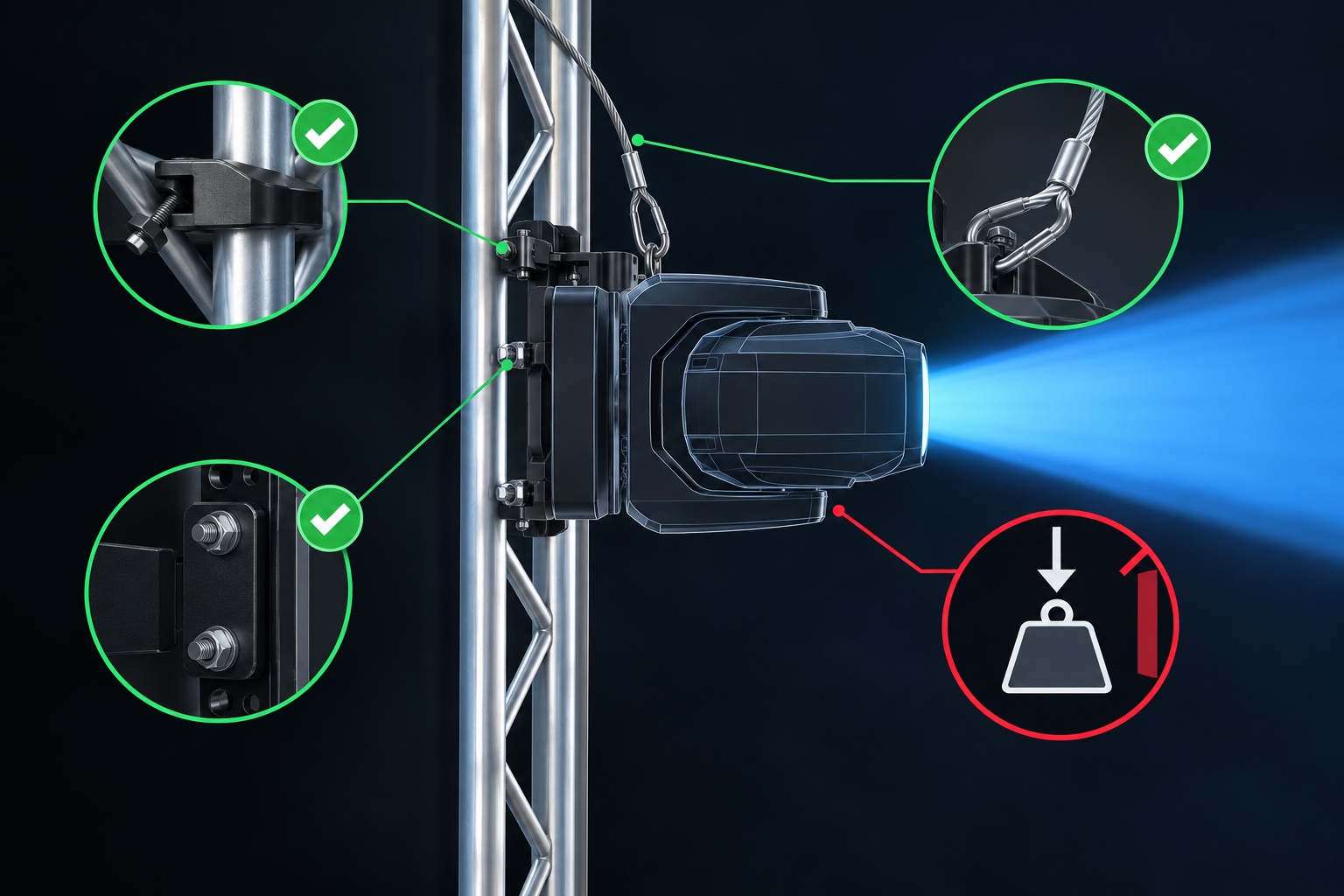
Moving heads are often hung on vertical truss, such as side-light towers or booms, or mounted with the base turned sideways. This changes how the fixture's weight is carried and how the safety cable is routed. It may also affect the fixture's operation.
This article covers the general approach. Anything that depends on a specific fixture is marked with a placeholder to be confirmed.
Before you start
Work through these checks before any hardware is fitted. Each one can rule out a mounting position.
Confirm the fixture is approved for sideways or vertical mounting. Some fixtures are designed to run in any orientation. Others have restrictions on mounting angle. [confirm: which fixture ranges permit sideways or vertical mounting, and any angle limits]
Check the fixture's weight against the load ratings. Compare it with the working load limit of the clamps, the truss, and the supporting structure. The weakest rated item sets the limit for the whole assembly. [confirm: where to find the fixture weight]
Confirm that the truss or tower is rated for the added side load. A fixture hung off a vertical tube applies a bending load that a fixture hung below a horizontal truss does not. Have a qualified rigger or the truss manufacturer's documentation confirm this.
Check whether the light source has orientation limits. Some lamp types have restricted burning positions, and operating them outside those positions can shorten lamp life or cause failure. [confirm: lamp or light source orientation limits for the relevant fixtures]
Read the fixture's user manual for any mounting warnings. [confirm: manual reference for mounting orientation]
Hardware
Use only rigging hardware that is rated for the load and marked with its working load limit. Hardware without a visible rating cannot be checked against the fixture's weight.
You will need:
Clamps suitable for the truss tube diameter, such as half-coupler or similar clamps. [confirm: recommended clamp type and fixing hardware for the fixture's mounting points]
A secondary safety attachment, such as a safety cable or steel wire rope rated for the fixture's weight.
Any quick-lock or mounting adapters supplied with the fixture. [confirm: supplied or recommended mounting accessories]
Do not use damaged, deformed, or unrated hardware.
Hanging the fixture on vertical truss
Inspect the clamps, truss, and safety cable for damage before use.
Decide on the fixture position and the direction it will face. Check that the head has clearance to pan and tilt through its full range without striking the truss, other fixtures, or cables.
Attach the clamps to the fixture's mounting points, following the fixture's instructions. [confirm: mounting point locations and fastener torque, if specified]
Fit the clamps to the truss tube and tighten them fully. On a vertical tube, a clamp is held mainly by friction and clamping force, so check that it cannot slide down the tube. Your rigger may require a method of preventing slippage. [confirm: any supported method for preventing clamp slippage on vertical truss]
Fit the safety cable so that it passes around the truss chord and through the fixture's designated safety attachment point. Keep the cable short enough that the fixture cannot fall a significant distance if the clamp fails. [confirm: location of the fixture's safety attachment point]
Check that the cable is not carrying load in normal use and that it is not trapped by moving parts. The safety cable is a secondary attachment. It should take load only if the clamp fails, and moving parts can damage it or be blocked by it.
Connect power and data cables. Leave enough slack for the head to move, and secure the cables to the truss so they do not hang from the connectors.
Check that all clamps, bolts, and locking devices are tight.
Hanging the fixture sideways on any truss
When the fixture's base is turned to the side, the same steps apply, with these additional checks:
Confirm that the orientation is permitted for the fixture. [confirm: permitted mounting orientations]
Check that the safety cable still runs to the correct attachment point and that the fixture would hang from it, not from its cables. Power and data cables are not designed to carry the fixture's weight. [confirm: the source text ends at this point; add any further sideways-mounting checks that were intended]