
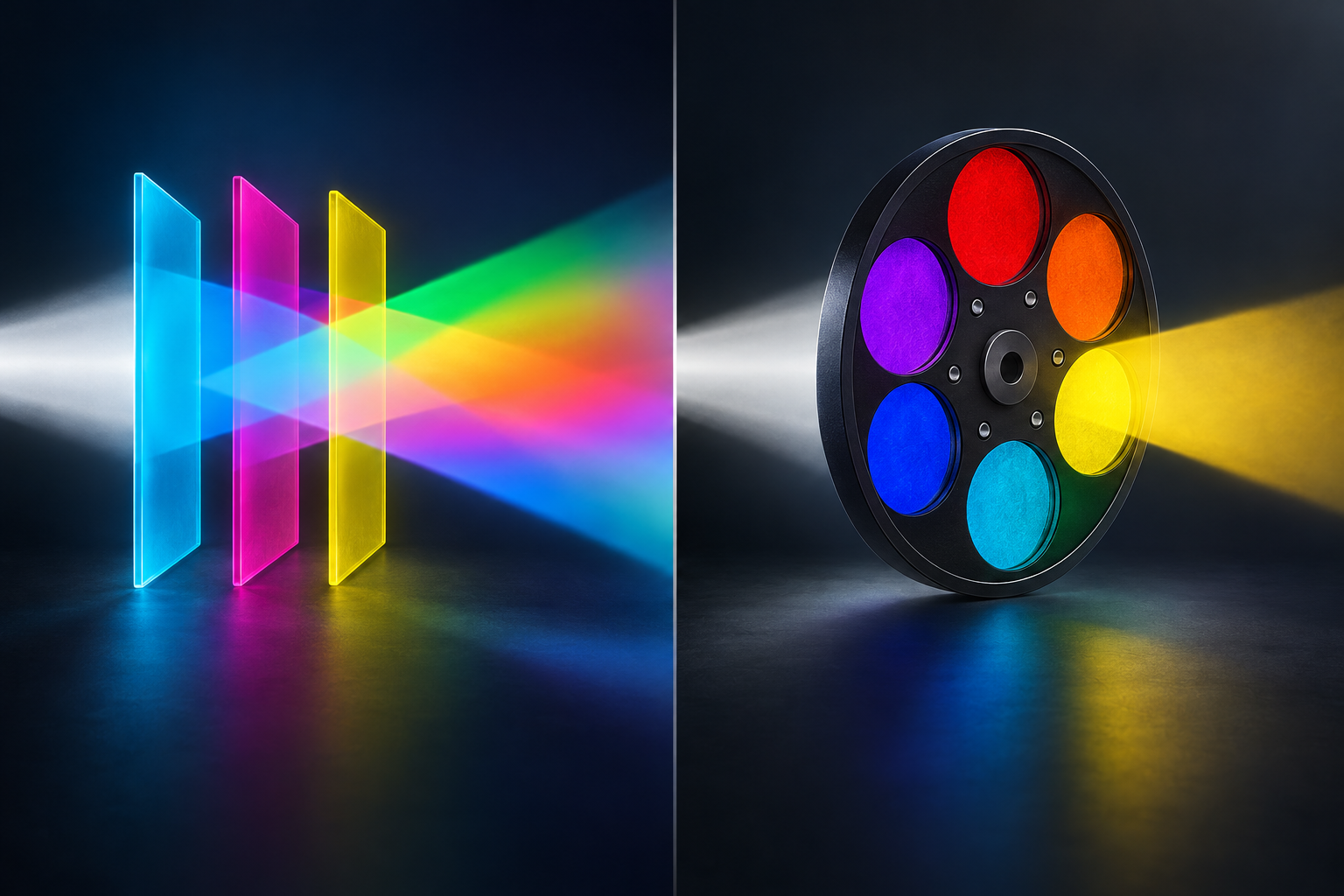
Moving lights produce color in two main ways: by selecting a fixed filter from a wheel, or by mixing color continuously with graduated flags. Each method has different strengths, and the choice affects how you can program transitions.
[confirm: which fixture ranges use each mechanism]
Fixed Dichroic Wheels
Fixed dichroic wheels use single glass filters mounted on a rotating carousel. Each filter is a discrete piece of glass with a fixed color, so the fixture can only show the colors that are physically on the wheel.
This design has the following characteristics:
Instant optical snap changes (sub-100ms). The wheel moves directly from one filter to the next, so color changes can be very fast.
Maximum light transmission (up to 90% depending on dye/coating). The exact figure depends on the dye and coating used for each filter.
Limited transitions. Because the colors are discrete filters, transitions are limited to split-color boundaries, where the beam straddles two filters, or hard sequential cuts from one filter to the next.
Subtractive CMY Mixing
Subtractive CMY mixing inserts graduated cyan, magenta, and yellow dichroic flags progressively into the optical beam. Each flag removes part of the spectrum from the white light, and the further a flag enters the beam, the stronger its effect. Combining the three flags at different depths produces a wide range of colors.
This enables:
Continuous spectrum transitions. Because the flags move gradually, the color can change smoothly rather than stepping between fixed filters.
Pastel rendering. Inserting a flag only partway removes only a small part of the spectrum, which produces light tints.
Precise CCT correction. Fine adjustment of the flags lets you shift the apparent warmth or coolness of white light (correlated color temperature, or CCT).
Programming Complex Transitions
Cross-Fading Between Complementary Hues
When cross-fading between complementary hues (e.g., cyan to amber), linear CMY movement passes through a muddy center gray or desaturated center state.
This happens because the flags move in a straight line from one color to the other. Partway through the move, the flags are mixed in proportions that remove light across much of the spectrum. The result is a dull, desaturated color between two vivid ones.
Design Solution
To preserve visual brilliance, use one of these approaches:
Program a curved intensity dip. Reducing intensity through the middle of the transition makes the desaturated center state less noticeable.
Route the color path through high-chroma transitional colors (e.g., passing through magenta or saturation dips) instead of moving in a straight line between the two colors. The beam then stays vivid for the whole transition.